
Homepage - Osloop
Speed up your research data analysis!

Osloop tool provides statistical analysis and instant results

We help researchers and statistical analysts transform their studies into clear,
actionable quantitative data—without complications—using a single tool.
Why Choose Osloop?

What makes Osloop stand out? Why us in particular?!

Because you need easy and accurate tools that help you analyze your data and present results professionally and quickly—without requiring any prior experience.
Accurate analysis based on established methodologies.
Osloop relies on validated research models to generate actionable quantitative data instantly, enhancing the accuracy of your decisions.
Flexibility that suits everyone.
The platform is suitable for statistical analysts and researchers across various fields, supporting a wide range of analyses tailored to your specific needs.
Easy and fast-to-use interface
We designed Osloop with a simple and intuitive interface that allows you to perform statistical analyses through clear, straightforward steps—without any complexity.
How does the tool work?

4 Simple Steps to Turn Your Research into Accurate Data

Statistical Methods

All statistical methods are
accurate and based on international
standards

You’ll find all the statistical methods you need to transform qualitative data into accurate and reliable quantitative outputs.
  • Independent Samples t-Test
    A statistical test used to compare the means of two independent groups to determine whether there is a statistically significant difference between them in a specific variable.
  • McNemar’s Test
    A non-parametric statistical test used to analyze changes in binary responses for the same sample under two related conditions (such as before and after), to determine whether the change is statistically significant.
  • Cronbach’s Alpha Reliability Coefficient
    A statistical measure used to assess the internal consistency reliability of a set of items within a questionnaire or test, ensuring the measurement tool is reliable.
  • Difficulty Index and Discrimination Index
    Used to evaluate the quality of test items; the difficulty index measures how easy or difficult a question is, while the discrimination index assesses the item’s ability to distinguish between high- and low-performing individuals.
  • Chi-Square Test and Fisher’s Exact Test
    Statistical tests used to examine the relationship between two categorical variables and determine whether a statistically significant association exists between different categories.
  • One-Way ANOVA (Analysis of Variance)
    A statistical test used to compare the means of three or more independent groups to determine whether there are statistically significant differences among them for one independent variable.
  • Kruskal–Wallis Test
    A non-parametric statistical test used to determine differences among three or more independent groups when the assumption of normality is not met, to assess whether statistically significant differences exist.
  • Wilcoxon Signed-Rank Test
    A non-parametric statistical test used to compare two related samples when the data do not follow a normal distribution, such as measuring changes before and after an intervention.
  • Mann–Whitney U Test
    A non-parametric statistical test used to compare differences in ranks between two independent groups when the data do not meet the assumption of normality.
  • Paired Samples t-Test
    A statistical test used to compare the means of the same sample under two different conditions (such as before and after) to determine whether a statistically significant change has occurred.
  • One-Sample t-Test
    Used to compare the mean of a single sample with a known or hypothesized population mean to determine whether there is a statistically significant difference.
  • Descriptive Statistics
    A branch of statistics concerned with summarizing and describing data using measures such as the mean, standard deviation, and graphical representations, making data easier to understand and interpret.
  • Frequencies and Percentages
    Used in descriptive statistics to present the number of cases in each category (frequency) and the proportion they represent of the total sample, helping to clearly illustrate data distribution.
  • Spearman Correlation Coefficient
    A statistical measure used to assess the strength and direction of the relationship between two ordinal or non-linearly related variables, especially when the data do not follow a normal distribution.
  • Internal Consistency
    A measure used to evaluate the degree of correlation and homogeneity among items within a single measurement instrument, reflecting the reliability of the tool in measuring the intended construct.
  • Normality Test
    A statistical test used to determine whether the data follow a normal distribution, which is a fundamental assumption for selecting appropriate statistical methods and ensuring accurate data analysis.
  • Independent Samples t-Test
    A statistical test used to compare the means of two independent groups to determine whether there is a statistically significant difference between them in a specific variable.
  • McNemar’s Test
    A non-parametric statistical test used to analyze changes in binary responses for the same sample under two related conditions (such as before and after), to determine whether the change is statistically significant.
  • Cronbach’s Alpha Reliability Coefficient
    A statistical measure used to assess the internal consistency reliability of a set of items within a questionnaire or test, ensuring the measurement tool is reliable.
  • Difficulty Index and Discrimination Index
    Used to evaluate the quality of test items; the difficulty index measures how easy or difficult a question is, while the discrimination index assesses the item’s ability to distinguish between high- and low-performing individuals.
  • Chi-Square Test and Fisher’s Exact Test
    Statistical tests used to examine the relationship between two categorical variables and determine whether a statistically significant association exists between different categories.
  • One-Way ANOVA (Analysis of Variance)
    A statistical test used to compare the means of three or more independent groups to determine whether there are statistically significant differences among them for one independent variable.
  • Kruskal–Wallis Test
    A non-parametric statistical test used to determine differences among three or more independent groups when the assumption of normality is not met, to assess whether statistically significant differences exist.
  • Wilcoxon Signed-Rank Test
    A non-parametric statistical test used to compare two related samples when the data do not follow a normal distribution, such as measuring changes before and after an intervention.
  • Mann–Whitney U Test
    A non-parametric statistical test used to compare differences in ranks between two independent groups when the data do not meet the assumption of normality.
  • Paired Samples t-Test
    A statistical test used to compare the means of the same sample under two different conditions (such as before and after) to determine whether a statistically significant change has occurred.
  • One-Sample t-Test
    Used to compare the mean of a single sample with a known or hypothesized population mean to determine whether there is a statistically significant difference.
  • Descriptive Statistics
    A branch of statistics concerned with summarizing and describing data using measures such as the mean, standard deviation, and graphical representations, making data easier to understand and interpret.
  • Frequencies and Percentages
    Used in descriptive statistics to present the number of cases in each category (frequency) and the proportion they represent of the total sample, helping to clearly illustrate data distribution.
  • Spearman Correlation Coefficient
    A statistical measure used to assess the strength and direction of the relationship between two ordinal or non-linearly related variables, especially when the data do not follow a normal distribution.
  • Internal Consistency
    A measure used to evaluate the degree of correlation and homogeneity among items within a single measurement instrument, reflecting the reliability of the tool in measuring the intended construct.
  • Normality Test
    A statistical test used to determine whether the data follow a normal distribution, which is a fundamental assumption for selecting appropriate statistical methods and ensuring accurate data analysis.
Want to collaborate with us?

Smart solutionsfor statistical analysis for researchers and statistical analysts.

We’ve made statistical analysis easy for you! Just upload your data, choose the appropriate method, and get professional, accurate results.
Review of the procedural aspect of the research
We provide you with a smart and comprehensive solution for statistical analysis—accomplishing in minutes what might take hours, and delivering accurate, instant results.
Interpretation of Graphical Results
Say goodbye to the complexity of traditional software—start your analysis with just one step.

Hold meetings with Osloop analysts
No need to deal with cumbersome tools or complicated steps—our platform does the work for you. Just choose the right method and receive professional support.
Adding recommendations and suggestions
We’re with you from start to finish—to help you achieve satisfying and impressive results.
Results Analysis
“Osloop”… where data becomes insight, and time turns into opportunity.
Plans

Packages & Pricing

Choose the right plan and get the best features.
200
Basic Plan
Includes statistical data analysis and organization into statistical tables.
Data Handling
Results Analysis
Charts and Graphs
Expert Review
Table Generation
Export as Word file
Table Interpretation
Interpretation of Results
Writing Results and Recommendations
400
Standard Plan
Includes statistical data analysis with interpretation of statistical tables.
Data Handling
Results Analysis
Charts and Graphs
Expert Review
Table Generation
Table Interpretation
Export as Word file
Interpretation of Results
Writing Results and Recommendations
600
Comprehensive Plan
Designed to complete the entire statistical work—from research procedures to results and recommendations.
Data Handling
Results Analysis
Charts and Graphs
Expert Review
Table Generation
Table Interpretation
Interpretation of Results
Writing Results and Recommendations
Export as Word file
What They Said About Us!

What Our Valued Clients Said About Us!

Browse the experiences of our previous clients—from professionals to students—and discover the features we provided them.
  • شكرًا لكم على هذا التنظيم الاحترافي في إرسال الإيميلات، تحديد المواعيد، روابط الجلسات، وسرعة الاستجابة للدعم والأسئلة. المدربة كانت ممتازة ومتفاعلة، وقدمت المادة العلمية بشكل سلس وواضح من خلال عرض السلايدات واستخدام الأمثلة. سعدت جدًا بالرحلة التعليمية معكم ولن يكون آخر تعامل . (إحدى المستفيدات من دورة التحليل الإحصائي من أسلوب)

    أكاديمية
    تخصص طب
  • تسلم إيدك أخي الكريم وزادكم الله علماً وبركة ووسع عليكم من أبواب رزقه وعطائه شكرا جزيلا على العمل المنجز، أجدتم وتفضلتم علينا بهذا التقرير الرائع

    أكاديمي
    تخصص إدارة
  • السلام عليكم ورحمة الله وبركاته بعد الاطلاع الدقيق على الملف اود القول انه من لا يشكر الناس لايشكر الله أجدتم العمل بكل حرفية واتقان وسعدت بالتعامل معكم ومن باب نشر العلم سيشرفني نقل تجربتي لغيري من الباحثات عسى الله ان يشملني في أجر (علمٌ يُنتفع به)

    طالبة دكتوراه
    تخصص تربية
  • أداة احترافية وسهلة جداً. ساعدتني أخلص تحليلي في أقل من ساعة، غير كذا اسعارهم والميزات إللي قدموها لي بعد التحليل ممتازة

    مراد
    طالب ماجستير
  • والله صراحة كلمات الشكر ماتوفيكم حقكم صبرتوا معي كثير والعمل انا راجعته كان ممتاز جدًا والتصميم رائع وحتى وقت التسليم كان قياسي جدًا ممتاز ورائع الله يعطيكم الف عافيه وباذن الله مو اخر تعامل بينا

    طالبة ماجستير
    تخصص صيدلة
Osloop blog

Explore Our Insights…

An interactive blog where you’ll find the latest specialized and general articles…
Especially for Students

Get Free Statistical Analyses!!

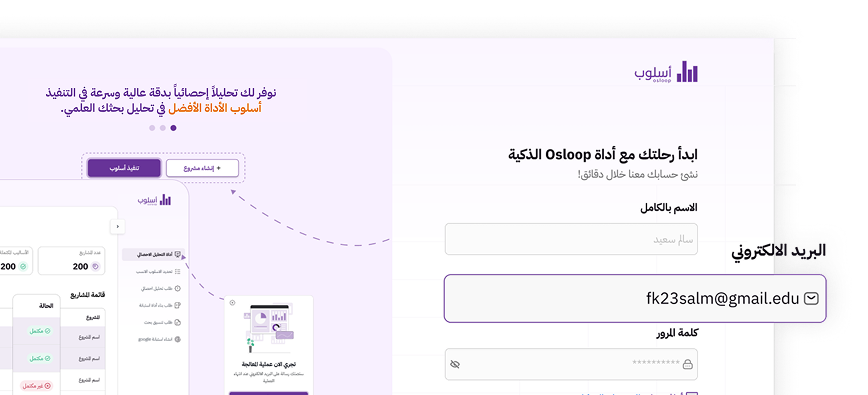
Sign up with an educational email ending in .edu and receive free analysis credits.
Order a statistical analysis now 📊